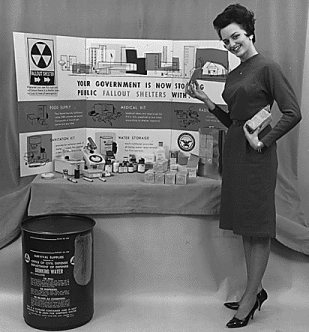
Community Fallout Shelter Supplies
Supplies In Community Fallout Shelters
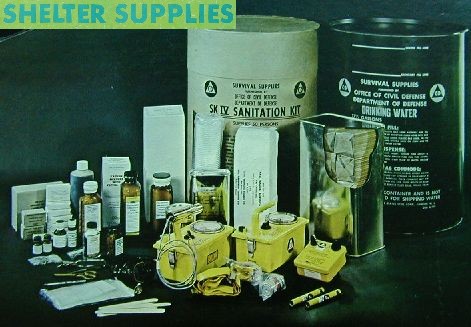
During the Community Fallout Shelter program the Office of Civil Defense provided supplies to be stocked in marked community shelters. These supplies were very minimal survival supplies which would have provide shelterees with food, water and sanitation needs for an allotted 2 week shelter stay. The plan was to provide each shelteree with 1 quart of water per day, 700 calories of food per day, sanitation supplies and radiation detection instruments.
Water supplies were stored in metal 17.5 gallon water barrels. Food stocks came packaged in several different forms such as ration crackers, wafers and carbohydrate supplement (hard candy). Sanitation Kits contained various supplies such as toilet paper, cups etc. Of course in a nuclear war you just might need some Medical Kits which were also supplied. And finally, the most interesting of all of the supplies, the Radiation Detection Kits, were provided for shelters with over 50 spaces.
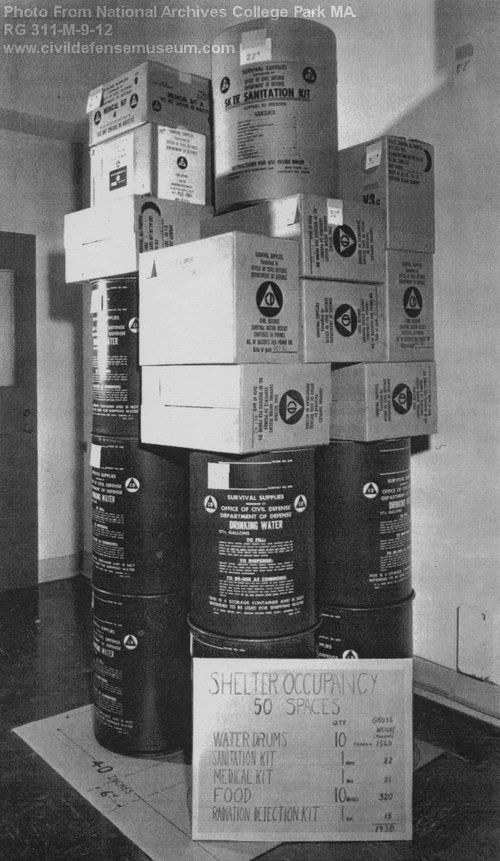
50 Space Shelter Supply Stock
This is a photo from the National Archives of a stock for a 50 person capacity Fallout Shelter. 10-Water barrels (5 persons each), 1-Sanitation Kit(50 persons each), 1-Medical Kit(50-65 persons each) and one Radiation Detection Kit(one every 50-1000 spaces). 10-Cases Food. Food mixes varied while stocking shelters. Carbohydrate Supplement, Crackers, Biscuits and Wafers were combined in different stocks. I believe the cases in this photo are all biscuits.
Obviously you wouldn't gain any weight at 700 calories a day during your shelter stay. With the minimal stocks that were provided it would have been just enough to stay alive. The Shelter Management Textbook does state that if there was a outbreak of illness let alone the effects of radiation that these supplies would have been severely taxed and supplemental supplies would have to be sought out.
This photo was sent to me by Dave Monteyne who did some digging through the National Archives at College Park, Maryland in November 2004. Thanks Dave! Click the photo to see a larger version.Reference SM-16.1 Shelter Management Textbook (July 1967).
Table of Fallout Shelter Supplies Purchased As of End Of FY 1966
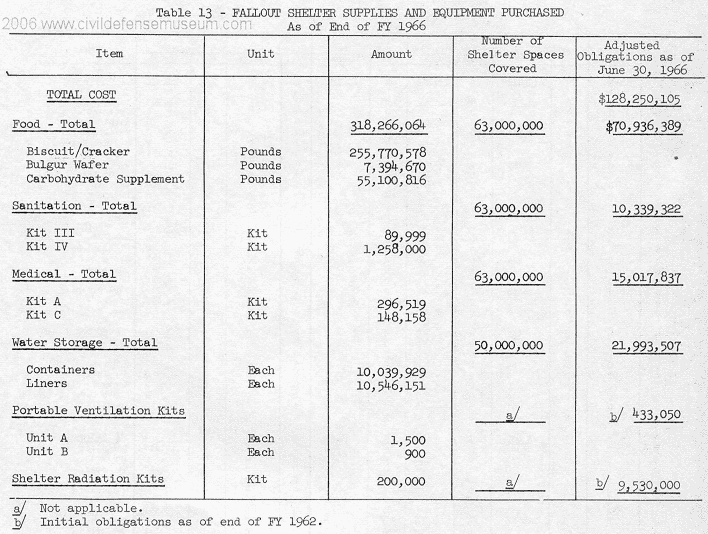
This table is from the DOD OCD 1966 Annual Statistical Report. It shows the totals of shelter supplies purchased as of the end of FY 1966. I believe that these should be the overall totals of fallout shelter supplies purchased because the DOD OCD 1965 Statistical Report states that no more general shelter supplies were procured in 1965. The totals on this 1966 table are the same as the totals found in the 1965 report except for the addition of the Portable Ventilation Kits (PVKs) and the shelter radiation kits at the bottom of the table. The 1964 and 1965 Statistical Reports have no information on the PVKs so I believe they were a late addition to the shelter supplies. The 1966 report states that "additional kit (PVK) procurement is planned after experience is gained with the above 2400 kits." The shelter radiation kits were the CD V-777-1 kit.
Some More Fallout Shelter Supply Info.
Here is something of interest I have found in my CD documents. Fallout shelter supplies were available for purchase by Federal agencies and State and local governments..
According to the Federal Civil Defense Guide Part D, Chapter 2, Appendix
2 Acquisition And Distribution Of Fallout Shelter Supplies.
Federal agencies, and State and local governments, have requested the Office
of Civil Defense to furnish a source from which they may purchase standard
fallout shelter supplies for use in stocking shelter facilities not eligible
for stocking under the National Fallout Shelter Marking and Stocking Program.
The items listed below are available to Federal agencies, and State and
local governments, on a reimbursable basis at prices listed with include
cost of transportation from the Defense General Supply Center, Civil Defense
Supply Division, Richmond, Va., 23219
| Federal Stock No. | Description | Unit of issue | Std. unit price |
| 6545-073-8385 | Sanitation Kit IV | Each | $8.20 |
| 6545-073-8384 | Medical Kit A | Each | $16.40 |
| 6545-073-8386 | RADEF Kit | Each | $59.00 |
| 8110-889-3532 | Water Drum Mtl Storage | Each | $1.90 |
| 8920-823-7667 | Crackers, 5 Gal. | Pound | $0.25 |
| 8920-823-7665 | Biscuits, 5 Gal. | Pound | $.025 |
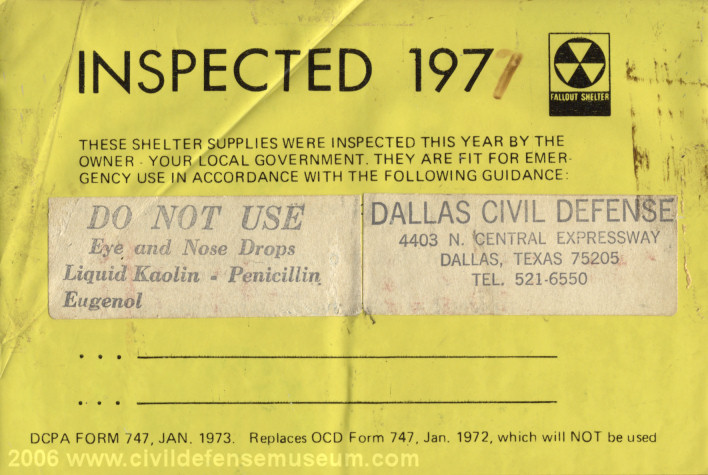 Fallout Shelter Supplies Inspection Sticker
This sticker is on one of my Medical Kit A boxes I got way back when. The City of Dallas kept tabs on their shelter supplies well into the 1970s. I think I have a Sanitation Kit somewhere with one of these on it too. I have never seen any stickers like this other than on supplies found in Dallas.
Click image to see larger.Excerpt from DCPA Civil Preparedness Guide 1-19 July 1978
I found the paragraph below in the DCPA CPG 1-19 and found it interesting because of
it's consise summary of the demise of the fallout shelter stocking effort.
The DCPA Circular 76-2 is mentioned. The DCPA 76-2 is a document I have long wanted to
locate. Eric Laskowski of the
Michigan Civil Defense Museum provided me with a scan of the DCPA 76-2 document so I included it below.
II. BACKGROUND
The stocking of fallout shelters began in the early 1960's when DCPA
procured 165,000 tons of shelter food. The food and other supplies
were granted to the States and localities, and placed in approximately
100,000 fallout shelters around the United States during the period
1962-1970. In 1969, it was decided not to renew efforts for Federal
stocking when it became obvious that Congress would no longer appropriate
funds for shelter supplies. In 1976, as the result of laboratory and
other tests, it was established that there was a high probability
that most of the cereal-based rations stored in fallout shelters had
became rancid. In view of these facts, DCPA Circular 76-2, Shelter
Supplies, dated September 29, 1976, was promulgated which provided
the status on the cereal-based food and medicines in shelters. It
authorized these stocks to be disposed of but recommended usable supplies
in the medical and sanitation kits to be retained in the shelters.
PURPOSE
The purpose of this circular is to provide the most recent information of
the condition of shelter supplies to assist local governments in making
decisions on the use and disposition of
supplies.
BACKGROUND
Shelter supplies consisting of food, medical and sanitation kits, and water
containers were procured by the Federal government between 1962 and 1964.
These supplies, when issued, became the property of local governments which
accepted responsibility for their storage, care, maintenance and inspection.
The specified shelf-life of these supplies was five years which has
been surpassed by seven to nine years, and it has been determined that some
items are no longer usable.
SHELTER MEDICAL KITS
The medicines in the medical kits have deteriorated badly and should be
destroyed. In the event there are still phenobarbital tablets (they should
have been disposed per guidance in 1971), you should request quidance regarding
disposal of tablets from the Regional Director, Bureau of Narcotics and
Dangerous Drugs (BNDD), Department of Justice. Special instructions govern
their disposition.
Phenobarbitol is a "controlled" substance under the Comprehensive Drug Abuse
Prevention Act of 1970 and your police department will know or be able to
obtain the addresss of the appropriate BNDD Regional office. The bandages
and other materials are usable.
CEREAL-BASED SHELTER RATIONS
In the past, DCPA has recommended that the food supplies remain in place
for emergency use as a supplement to other food. However, as a result of
recent laboratory and other tests, a high probability exists that all of
the cereal-based rations stored have become rancid. The laboratory report
indicates that rancid food irritates the stomach and intestinal tract of
humans and some animals causing vomiting and/or diarrhea. However, these
cereal-based rations are being used by some animal feed processors who mix
ground cereal-based rations whith other ingredients into animal feed. Cereal-
based rations stored in rusted or otherwise damaged containers are not used
by the feed processors. Since the degree of rancidity of cereal-based rations
cannot be determined accurately, DCPA recommends that they no longer be considered
for human consumption. It is recommended that ceral-based rations no longer
be considered as shelter supplies and should be destroyed or disposed of.
If processors plan to use such mixtures for animal feed, they should avail
themselves of laboratory reports from DCPA.
GUIDANCE ON DISPOSITION OF SHELTER SUPPLIES
The sanitation items, as well as the bandages and medical equipment, are good
and should be used as deemed appropriate by the local government.
Disposal of food and medicines should be in accordance with State and local
law and disposal regulations.
This guidance on disposition does not apply to the Shelter Radiation Detection
Kits, CD V-777-1. Any relocation or disposition or these kits should be
referred to the State Radiological Inspection, Maintenance and Calibration
Facility for appropriate action.
SUPERCESSION
DCPA Circular 74-2, dated January 30, 1974, is hereby supersceded.
To download the complete CPG 1-19 DCPA click here DCPA CPG 1-19 in Adobe Acrobat format.